Annotations, Part II: Taming of the Script

Today we return to the subject of annotation in playwriting. POW casting director Melinda Marks tells us the tone that she’d adapt in her version of Shakespeare’s Taming of the Shrew:
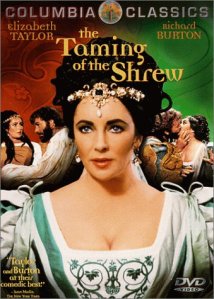
shreMelinda:

I get why people have a problem with the play, and I saw a version of it in Virginia that was very true to the script; it wasn’t edited at all. It was played very straight. For some reason, it didn’t sit well with me, and not because I wasn’t comfortable with the play. It was because I thought it was a cop-out. The actress who played Kate played it completely straight, like she was having this revelation. In my optimum version of the play, you have this guy who comes to Mantua to get a wife because he’s rich as heck, and he has all these landholdings and all this money, and now he wants to accumulate more wealth for his retirement. He wants to marry a rich woman to get a good dowry and increase his landholdings.

If the richest guy in town’s daughter is kind of a bitch and a half, it doesn’t matter to him, because it’s an investment. And everybody is so eager to get rid of her that they agree to this. But he meets her and likes her, because what he doesn’t expect is how witty she is, because nobody says that. Nobody says, she’s smart, or she gets all those zingers in. Everybody says she’s terrible. So then he meets her and he likes her.

I want to see a version where he sees that he has all this, and has this wife, and he realizes that he doesn’t know how to be a husband. He wants to know how to get control of the situation because he’s a businessman. He has no confidence. This is how I always thought about it. How is he going to deal with the fact that now he’s secured this investment, but it’s so unstable? So he tries to.

There are things that can justify this in the script; you just have to find them and you have to bring them to the surface. He’s acting mean to keep her off balance. The annotations that I made show that he doesn’t know what else to do. There’s a moment in the middle of that, when she’s been living at his house and acting crazy for a couple days, she says, in so many words, “Listen: I have to say what I feel. Because if I keep what I feel inside, I will die. My heart will break. I have to be free. You can’t keep me from being who I am, because at the very least, I will say what I please. And if you love me or you don’t, that’s it.”

It’s in the script. I didn’t have to change anything.

Julia:
So what appeals to you about this play?

Melinda:
I want the dynamic between the two of them to be frank. I want to see him sweat.  I want to see him not be confident. In a lot of versions he’s made to be very confident, like he’s had this plan all along, to tame this woman. But he didn’t have an idea. His idea was to get money. And he did. He improved his status significantly, and beyond that I want to see him sweat it out. I want to see him not in his element.

Julia:
It’s like that horrible song, “Blurred Lines”.

Melinda:
Not really. That song said, “of course you want to be with me.” It’s a different vibe. But I want to see a version where Petruchio is really nervous.

Julia:
So are you going to write that version?

Melinda:
The version is already there. It’s all there.

Julia:
You’re going to adapt that?

Melinda:
I don’t even have to. I just have to make cuts.

Julia:
Are you going to do it for Play On Words?

Melinda:
It’s a Shakespeare play, so, no. Are we prepared to mount a full Shakespeare play?

Julia:
Not at all. But we could workshop it.

Melinda:
Oh my gosh. But I want to see him sweat. I don’t want to see her get psychologically tortured. I don’t mind her being vaguely uncomfortable.I don’t mind her thinking, is he trying to break my will? I don’t mind that, but when she says listen, this is who I am, that’s the moment.

I want that to be the moment where they decide that they are going to have to make this work on each other’s terms. That is what is missing from a lot of other versions. And it’s not because they don’t try to make it seem like he’s right or that she comes out on top.

I’ve seen a lot of versions like that. I want to cut the script into something where, not only does Kate come out on top and feel that she can make this marriage successful in her own right, even though she didn’t get married on her own terms. I want to see this guy squirm. I would like a version where the two of them recognize that about each other and are able to move on based on that.

Tune in next week to learn how annotation can shed light on the creative process. Don’t forget: we need submissions, especially works of theater! Email submissions for our spring show to playonwordssj@gmail.com

What is Annotation? [Part One]

At Play On Words, we like to read. We like to write. You know those magnetic poetry kits you can use on your fridge? We got those. This spring, as we plan ahead for our next show, we’re busy reading, writing and discussion production. In addition to rehearsing, performing, teaching and curating, Play On Words Casting Director and co-founder Melinda Marks is busy adapting Shakespeare plays. She agreed to share some thoughts on the process of annotation, and how adaptation can help writers reflect on their own artistic processes. Today’s post is the first of three in a series we’ll be sharing over the next few weeks on the art of annotation.

Julia:
So Melinda, you are a playwright slash dramaturg, director, actress. Tell me what it means to annotate a play.

Melinda:
With anything, it’s making notes that are relevant, making notes about what other people have said about something, anything that contextualizes a piece of writing for a reader or an audience. I decided that I was going to annotate some Shakespeare plays for fun. I’m just doing a cut of the play, how I would like to see it done, edited how I would like to see it edited, in order to make a cleaner and clearer version of what I imagine the play to be about. It isn’t radically different from how it started, but it’s different enough that if whatever imaginary people might read or watch this version of the play, if they had any questions about it, then I would be addressing those cuts in as bold and defensive manner as I can.

Julia:
Do you actually cut lines?

Melinda:
Yea.

Julia:
What’s an example of a change you made?

Melinda:
With Hamlet, I actually ended up cutting about 50 percent of all the dialogue. I made it really short because I wanted to see a version where the only time that Hamlet really talked a lot was when he was alone. And that’s very different from the version where everyone has these long speeches, especially Hamlet. When he’s alone he goes on and on to the audience. But I decided that I was going to make it really dense. And that’s because I wanted a version of Hamlet that was really scary, where people weren’t really saying anything, or a lot of it was represented visually. That’s a choice, and I justified it at the time.

Julia:
Did you stage it?

Melinda:
No. I don’t have that kind of pull. If I were ever to stage it, I would go into it being able to justify it, not only to whoever was on my creative team, based on what I wanted, but already having that version, having thought about it.

I went to Virginia recently and I saw three Shakespeare plays and none of them were edited. I saw a version of the Taming of the Shrew, and while I don’t have a problem with it, a lot of people do, because of the lighthearted psychological torture that happens.

Julia:
Which part makes people uncomfortable?

Melinda:
The fact that Petruchio marries Kate for her money, and she’s a mean person, so he decides to give her a taste of her own medicine. Once he takes her back to his house, there are these references to the fact that he’s denying her food, or he’s denying her sleep. And they are played for laughs, and that makes me think that it was played very broad and very silly, and at the end the conceit is that they go back to her dad’s house, and everybody says, she’s so different, and there’s this speech about marital obedience at the end. A lot of people have different approaches to this, with different degrees of tongue-in-cheek.

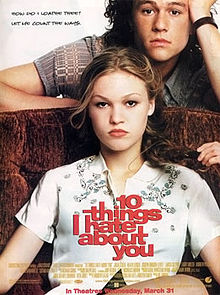
Ten Things I Hate About You
Source: Wikipedia

Julia:
Isn’t Ten Things I Hate About You based on Taming of the Shrew?

Melinda:
Yea.

Julia:
That’s my cultural reference.

Melinda:
In 10 Things I Hate About You, Kate realized that she wanted more than herself, and that she could still be who she was, but also fall in love, be in love with someone at the same time. The switcheroo there was that Petruchio made a bet, but he felt bad about it. A lot of people play it with different degrees of that. I’ve always considered it to be the fact that it should be a joke, that that should never be taken seriously.

Stay tuned next week to hear Melinda’s thoughts on adapting Taming of the Shrew.

Danes in an Alley

Are you ready for a fresh take on Hamlet? Our closing piece at the 2014 Lit Crawl in San Francisco’s Clarion Alley was Melinda Marks’ award-winning short play, “Danes in Purgatory,” originally created and performed at San Jose State University’s 48-Hour Play Festival in September. In case you weren’t there to witness it, here are Melinda Marks, Ryan Alpers, Jeremy Ryan and Brian Van Winkle performing her piece:

http://https://www.youtube.com/watch?v=8RRz-rxtx0s

Feeling inspired? We’re currently seeking submissions for our upcoming shows and would love to read your work! Send submissions <2000 words to playonwordssj@gmail.com.

Kirstin Chen’s “Boys on the Roof”

Happy Monday!

We’re excited to kick off this week by featuring Melinda Marks’ performance of “Boys on the Roof,” a wonderful short piece by fiction writer and regular POW contributor Kirstin Chen. We were lucky enough to read an excerpt of her new novel, Soy Sauce for Beginners, back in February, and were delighted to receive this submission in time for our Lit Crawl show. Here’s Melinda “Boys on the Roof” on October 18 in San Francisco’s Clarion Alley:

Thanks, Kirstin, for your beautiful words, and for joining us last weekend! What a treat.

“Unigirl,” by Leah Griesmann

We chose Leah Griesmann’s “Unigirl” for the Lit Crawl reading in part because it fit our San Francisco setting so well. The entire story, which you can read at Pif Magazine, is masterfully written, but we only had time to read a brief excerpt. Leah was unable to join us on Saturday because she is en route to a writing residency at the MacDowell Colony, a wonderful honor and opportunity. Here’s a clip of Melinda Marks performing an excerpt of “Unigirl” at Clarion Alley this past weekend:

We hope to film or tape Melinda reading the story in its entirety soon. Stay tuned for more Lit Crawl recordings this week–and please submit to our next show!

Lit Crawl Success!

We did it: we filled San Francisco’s Clarion Alley last Saturday night for our Lit Crawl debut. What a terrific night. We couldn’t have done it without the support of the amazing Lit Crawl crew–Renee Senogles, Andres Bella, Lisa Church and Travis Peterson–as well as Lyra Halprin, our day-of photographer, and Rick Alpers, our trusty videographer. A million thanks to all of you who came out to revel in good words.

And, for those of you who missed it, here’s our first installment from Saturday night’s show, featuring Andres’ introduction and our re-production of Brian Van Winkle’s brilliant play, “The Way I Picture it In My Head,” as performed by Brian Van Winkle, Melinda Marks, Jeremy Ryan, Ryan Alpers, and Michael Weiland. Enjoy.

Coming soon, to Clarion Alley…

Play On Words is thrilled to represent South Bay at the 2014 LitCrawl in San Francisco on October 18! This show celebrates our one-year-anniversary as a collaborative reading series–and as such, we’ve curated an exciting show that showcases some of our most frequent contributors:

Leah GriesmannLeah Griesmann‘s stories have recently appeared in Union Station, The Cortland Review, J Journal: New Writing on Justice, The Weekly Rumpus, and PEN Center USA’s The Rattling Wall. A 2010-2011 Steinbeck Fellow in Fiction, she is the recipient of a 2013 DAAD grant in fiction and a 2014 MacDowell Colony Fellowship. She is currently at work on a collection of stories.

Jimmy Allan read Leah’s story “Slave” at our October 2013 premiere. We will be performing an excerpt of her story “The Unigirl” in San Francisco.

Kirstin Chen is the author of Soy SaKirstin Chenuce for Beginners. A former Steinbeck Fellow in Creative Writing, she holds an MFA from Emerson College and a BA from Stanford University. She has received awards from the Sewanee and Napa Valley writers’ conferences. Her short stories have appeared in Zyzzyva, Hobart, Pank and others, and have been nominated for the Pushcart Prize and the Best New American Voices. Born and raised in Singapore, she currently lives in San Francisco, where she’s at work on her second novel, set on a tiny island off the coast of southern China in 1958.

Melinda Marks performed an excerpt of Soy Sauce for Beginners at our February 2014 show. (You can watch it here!) We will be performing her short story “Boys on the Roof” in October.

Brian Van WinkleBrian Van Winkle graduated from Southern Oregon University with a B.S. in Theatre Arts. He is a member of the Pacifica Table Readers. We performed Brian’s play “The Way I Picture it in My Head Is…” in February, and it was such a big hit that we are bringing it with us to San Francisco. He is a regular POW performer.

Nicole Hughes

Nicole Hughes completed an MFA in fiction writing from San Jose State University. Her story “Impasto Portrait” was published in Liebamour. As an MFA student, she was awarded the 2011 Ann Lillis Creative Writing Scholarship and the 2009 and 2011 James Phelan Literary Award. Nicole is one of POW’s three co-founders and the current events manager at Kepler’s Books. We’re thrilled to see her perform “Illimitable Space” in October.

Melinda MarksMelinda Marks has performed in the Bay Area for over 20 years, and has more recently begun trying her hand as a writer of short plays and as a director. She holds a BA from UCSC in Theater with an emphasis in dramaturgy, and an MA from San Jose State in Theater Studies. She will be performing her own translation of Dante’s short poems in October. As POW’s casting director, she has performed in every show. Check out our YouTube page to see a sampling of Melinda’s performances.

Julia Halprin JacksonJulia Halprin Jackson has an MA in fiction from UC Davis. She has received scholarships to the Tomales Bay Writer’s Workshops and Bread Loaf Writer’s Conference. Her work has appeared in West Branch Wired, California Northern, Fourteen Hills, Flatmancrooked, Sacramento News & Review, Fictionade, Fiction365, Catalyst and Spectrum. She will be reading a selection of 100-word-stories at our LitCrawl event–and as a POW co-founder, she is thrilled to bring South Bay writers to San Francisco.

Ryan Alpers

Ryan Alpers teaches English and journalism in San Jose. He has a B.A. in literature from the College of Creative Studies at the University of California, Santa Barbara, and a teaching credential from San Jose State University. While studying at the College of Creative Studies, he was published in the CCS Literary Magazine “Spectrum” and awarded the CCS Brancart-Richardson Award for fiction. A regular POW performer and contributor, he will be reading a few pieces for the October show.

Jeremy RyanJeremy Ryan is a POW actor who has performed as Chester “Cosmo” Collier in It’s A Wonderful Life: A Live Radio Play! at Broadway By The Bay. Other favorite roles include Biff Loman in Death Of A Salesman (Broadway West,) Dennis Shepard/Aaron McKinney in The Laramie Project (Foothill Theatre,) and Chevalier Danceny in Les Liaisons Dangereuses (Dragon Theatre.) Jeremy is a graduate of the Foothill Theatre Conservatory. You can watch his performance of Adam Magill’s “Only Customary” here. He will be performing at our October show.

So…what are you waiting for? Swing by the Mission District’s Clarion Alley on Saturday, October 18 at 6pm to check out our one-year-anniversary show!

We’re All “Sweet On You”

If you’ve never seen an insulin pump before, it looks a lot like an iPod. Our May show featured a short monologue by #POW cofounder Julia Halprin Jackson called “Sweet On You.” A draft of this piece was originally performed at UC Santa Barbara exactly 10 years ago. It seems fitting to have this piece performed by the stellar Melinda Marks a few weeks before Julia and her partner Ryan tie the knot. Curious? Here’s what you missed:

Thanks, Melinda, for this beautiful reading. Shot Bloks and Gatorade for all!


“Misery Olympics” Kills It at Spring Fling

Play On Words’ May 22 show, Spring Fling, featured some exciting new work by Bay Area writers. We were also thrilled to feature a new actor, Tiffany Viorge, who together with POW veteran Melinda Marks nailed Christine Keating’s biting play, “Misery Olympics.” Big thanks to our friends Bayard Nielsen and Teresa Fradejas Salazar, who functioned as our unofficial POW videographers. In case you missed it, you can watch the full play here:

We were excited to welcome back some POW friends and family to the Blackbird Tavern, who has acted as our gracious host for the past few shows. Thanks, also, to POW photographer Michelle Anderson, whose photos you’ll spot on our Instagram (@playonwordsanjose) and Facebook (Play On Words San Jose) pages. Stay tuned this week to catch more footage from May’s show.

Have you got a hidden talent?

Are you a writer or performer? Artist? Musician? Man (or woman) about town? We’re in the process of planning our 2014-2015 season and want to hear from people with special artistic skills. Shoot us a line at playonwordssj@gmail.com if you’re interested.