Marilyn’s “Snake” in “Paris”

We are huge fans of Marilyn Horn-Fahey’s short fiction–which is why we opened each act of our Words & Music show with one of her short stories. Here’s footage of Melinda Marks performing “April in Paris” on July 14 in San Jose’s St. James Park:

Thanks to Rick Alpers for filming our first act. Here’s Brian Van Winkle reading Marilyn’s second piece, entitled “Snake”:

Betsy Miller Gives Us a “Moment” in the Wind

When Melinda Marks started reading Betsy Miller‘s short story, “A Moment in the Rain,” the wind in San Jose’s St. James Park picked up. The temperature began to drop. Check out Melinda’s fabulous performance of Betsy’s chilling story:

Thanks to Michelle Anderson for capturing this on film.

POW fans might remember Betsy’s piece, “Bees,” that Adam Magill performed back in June. Betsy is one of the co-founders of Thinking Ink Press, a small independent press. She is currently working on a children’s picture book, Brooklynn Bunny’s Super Boots, and on a young adult novel called Dance, Interrupted.

Haunted by Sarah Lyn Rogers’ Prose

Thank you to everyone who joined us this week in San Jose’s St. James Park! We really appreciated the opportunity to fill our downtown park with stories and friends. Today we are excited to feature our first video footage from one of our returning authors, Sarah Lyn Rogers. Here’s footage of Adam Magill reading “Haunted”:

Melinda Marks read Sarah’s second piece, entitled “Mountain State”:

Thank you to Michelle Anderson for filming these pieces.

Sarah is a writer, editor, and illustrator from the San Francisco Bay Area. When Sarah’s not writing or doodling, she selects short fiction for The Rumpus, gives editorial feedback to young novelists through Society of Young Inklings, and writes snarky humanities content for an education website. For more of her work, visit http://sarahlynrogers.com.

Publications, Honors or Awards:

James D. Phelan awards in metrical verse, free verse, and familiar essay. Academy of American Poets’ Virginia de Araujo Award.

Recent publications:

“‘Sleeping Lady Plate,’ 1976” in Cosumnes River Journal

“‘You can never quite forgive’ (148),” in Caesura.

What inspired you to participate in Play On Words?

Sarah Lyn Rogers
Sarah Lyn Rogers

I submitted work for the last two performances, “Take Flight” and “Spring Fling.” Nicole Hughes, who used to be one of the PoW organizers, goaded me into submitting the first time. Now I’m hooked!

Which writers or performers inspire you?

I’m on a poetry kick again, rereading pieces I like by Matthew Zapruder and Erin Belieu. Leigh Stein is another writer I admire—she’s able to cram so many evocative objects and ideas into poetry that sounds both nostalgic and conversational. These poets in particular make me think, How did they do that? Can I?

Name a book or performance that fundamentally affected you.

Writing Down the Bones, by Natalie Goldberg, is something I come back to again and again. Her shtick is that she’s a Zen practitioner and a writer who had an epiphany: What if she used writing as her meditation, her practice? This book is about “writing practice”—which isn’t so much about honing a craft it is about letting your thoughts flow freely without judgment. Use a fast-writing pen. Don’t look back. Don’t erase. If you reread later and any of your  recorded thoughts have special resonance, go ahead and harvest them—but that’s not the goal.

Brian Van Winkle’s “Audition”

As we read submissions and gear up for our July 14 show in St. James Park, we’re “auditioning” new material to see how it will sound when performed aloud. It only makes sense to conclude our Take Flight series with this final short play by Brian Van Winkle, aptly titled “Audition”:

Thanks to Michael Weiland, Melinda Marks, Julia Halprin Jackson, and guest “singers” Ryan Alpers, Adam Magill and Brian himself.

We hope to announce our lineup for the July show in the next week, so stay tuned!

Arcadia Conrad Sees “Red”

Have you ever wondered what’s going on in Lady Macbeth’s head? Melinda Marks lets us into Lady Macbeth’s imaginings in her monologue, aptly titled “Red.” Here is the lovely Arcadia Conrad reading “Red” June 3 at Cafe Stritch:

Interested in Shakespearean adaptations? Check out our series on annotation this past spring.

And for all you writers out there: you’ve got less than a week to submit to our July show! You know what to do.

Hot Turkish Story For You

Women who travel: have you ever had to say “no” to someone in another country? Sometimes it’s not as easy as it sounds. Just ask the narrator in Valerie Fioravanti’s “Hot Turkish Man For You,” as performed by Melinda Marks on June 3 at Cafe Stritch:

If you like Valerie’s work (and how could you not?), you need to check out her book, Garbage Night at the OperaShe also offers writing workshops, bootcamp mentorships, and self-paced tutorials. If you’re based in Northern California, you’ll also like Sacramento Stories on Stage, and its sister program, Stories on Stage Davis.

Drumroll Please…Tomorrow’s Lineup!

It’s nearly time to take flight. We had our rehearsal on Saturday night and we are pumped to perform tomorrow at Cafe Stritch. Our playbills will be printed tomorrow–and in one last effort to spread the word, we’re sharing the full lineup for Play On Words: Take Flight here:

ACT ONE

  1. “Pink Suitcase,” by Tania Martin, read by Gray Performs
  2. “Van Tribe: The River” and “Dudley and Lisa,” by Rick Alpers, read by Michael Weiland
  3. “Bees,” by Betsy Miller, read by Adam Magill
  4. “Van Tribe: Pumpkin,” by Rick Alpers, read by Tiffany Edwards
  5. “Bride,” by Lita Kurth, read by Melinda Marks
  6. “Van Tribe: Miracle Ticket,” by Rick Alpers, read by Michael Weiland
  7. “Sirs Parchment” and “I Ride on the Bus Out to the Suburbs in the Searing Heat,” by Gary Singh, read by Ryan Alpers
  8. “Stage Kiss,” by Mara Sherman, read by Laurel Brittan, Gray Performs, and Ryan Alpers

    ACT TWO

  9. “Suburban Fantasy,” by Renée Schell, read by Adam Magill
  10. “Hot Turkish Man For You,” by Valerie Fioravanti, read by Melinda Marks
  11. “Red,” by Melinda Marks, read by Arcadia Conrad
  12. “Swimming Lessons,” by Pratibha Kelapure, read by Laurel Brittan
  13. “Scars,” by Andrew Christian, read by Ryan Alpers
  14. “Cardio Tai Chi,” by Sarah Lyn Rogers, read by Tiffany Edwards
  15. “Audition,” by Brian Van Winkle, read by Michael Weiland, Melinda Marks, Brian Van Winkle, Adam Magill, and Julia Halprin Jackson

As we gear up for the big show, we’d also like to extend our gratitude, once again, to The John S. and James L. Knight Foundation and the San Jose Downtown Association, as well as Steve and Max Borkenhagen of Cafe Stritch, whose support and guidance helped make this show possible.

San Jose Downtown Association

Annotations and the Creative Process [Part Three]

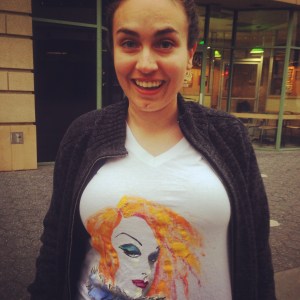
Today we bring you the final installment of our series on annotation in playwriting. POW casting director Melinda Marks explains how annotation can inform the creative process. As an added bonus: a photo of Melinda and the late, great Divine.
melindaJulia:
The process of annotating– has it made you think more about your own writing?

Melinda:
I think it’s made me think more about how I would direct. Because Shakespeare is so familiar. I mainly do this with Shakespeare–he’s so well-worn and comfortable, even if you know Shakespeare or if you’ve seen a lot of Shakespeare, you’re comfortable with stuff even if you don’t like it.

Even if I don’t like something, I can still think critically about, and why I don’t like it. I like seeing whether or not I can take things that I don’t like and mold them or change my thinking through critical reading and taking notes. Can I change this thing that not only is familiar, but I already have a set idea, set opinions about it? Can change my own mind so that it’s something that I like, something that I see differently?

I like to use this as a way with classical stuff to change my perspective on it.This enables me to visualize a different way; it gives me a chance to revisit the stuff and see if I still feel the same way about it.  If I’m going to make a cut, or don’t like a scene, why not?

I won’t cut something just because I don’t like it, but it will make me really think of the importance of leaving things in, or the emotional cost effectiveness of keeping something in or putting it out. It’s nice to see that you can have an effect on the arc of a story by changing the shape of it. Even if you keep all the characters, and you keep all the themes, if you change the shape or you change the length, how does it change? And why does it change?

It’s cool–even I don’t know if everything I’ll ever edit will be produced, but I like to think what would other people think of it. I know that not everyone would like it. What would people think of it, and why? I get jazzed thinking about all the discussions I could have with people about why they did or didn’t like something that I changed or that I cut, because that’s the thing about stuff that’s familiar. Stories that are familiar, plays that are done a lot–they can either be boring, or you can do what you can to make them interesting to you, and start discussion. I like to shake it up.

Julia:
Do you think we could someday produce something like that?

Melinda:
Sure, if y’all want.

Julia:
I’m ignorant to this process, though. Is there a rule about producing a version of a well-known play?

Melinda:
Shakespeare’s long dead. No royalties, I don’t think. I have a version of Hamlet that’s like an hour and twenty minutes.

Julia:
Is it funny?

Melinda:
No.

Julia:
Right. Hamlet isn’t funny.

POW fans and playwrights: Have you ever adapted anything? What was that process like and how did it inform your writing? We’re always looking for blog content, so if you have thoughts on the creative process that you’d like to share, feel free to comment here or email us at playonwordssj@gmail.com.